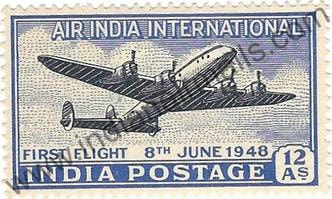
The Postage Stamp
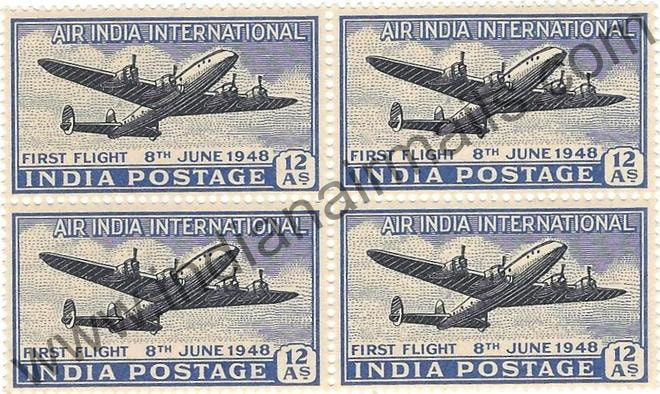
Block of four 12a. Stamps issued for use on 8 June 1948 to celebrate the first flight of Air-India International. The stamp on the bottom right of this block has the rare 'Extra Porthole' constant error.

Air-India International
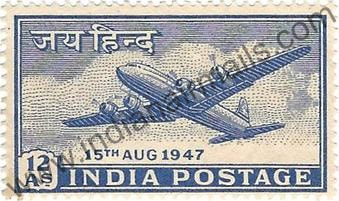
12a. stamp issued for use on 8 June 1948 only.
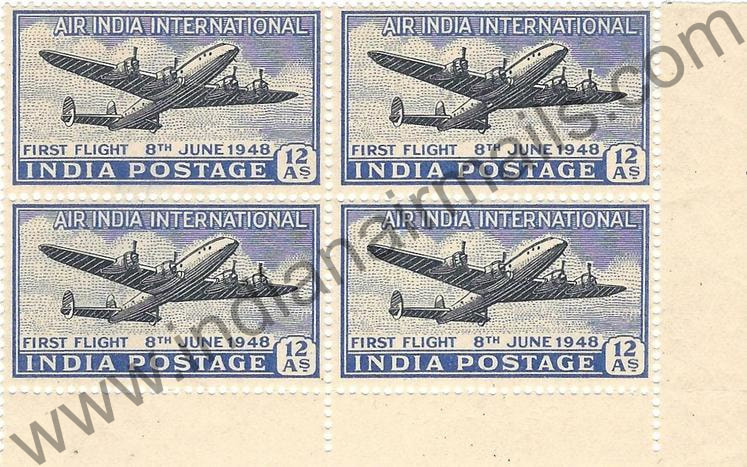
Constant Error - Broken Tail variety
Block of four 12a. stamp issued for the inaugural Air-India flight. The stamp in the bottom row, left side is the constant 'Broken Tail Error' stamp. Margins reveal the position of this stamp in the sheet.
Air-India International
12a. stamp issued for use on 8 June 1948 only. Block of 16 stamps.
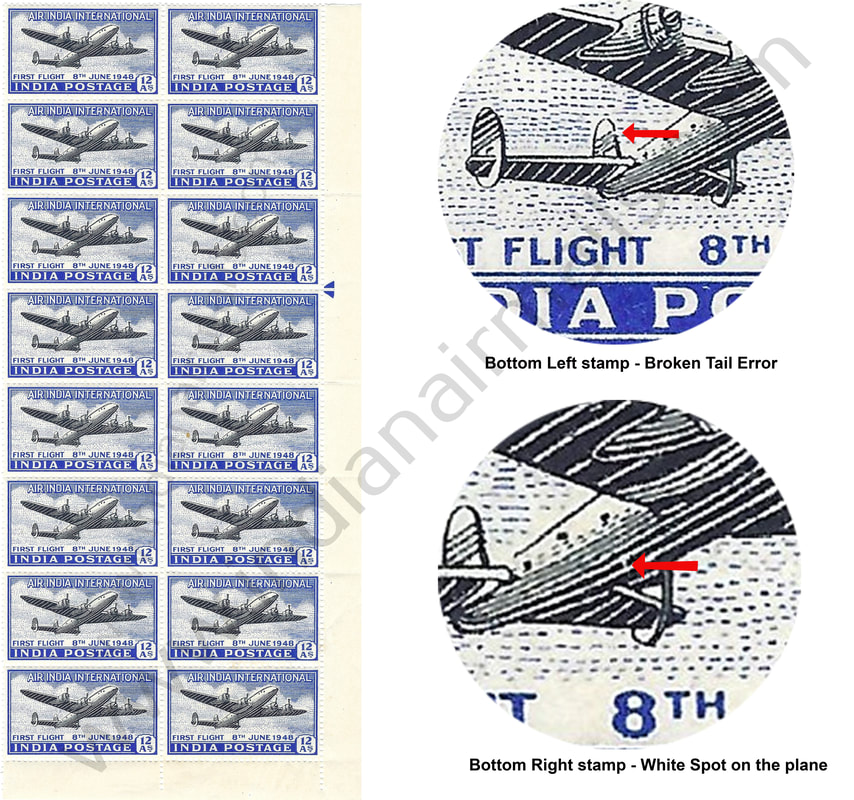
Block of 16 with Constant Error Broken Tail and White spot on the plane variety.
Block of four 12a. stamp issued for the inaugural Air-India flight.
India’s First International Air Service Commemorated
The year 1948 marked a defining moment in the history of Indian civil aviation. Following independence in August 1947, India sought to establish its own international air links and strengthen its global presence. This ambition was realized with the inauguration of the first overseas service of Air-India International.
|
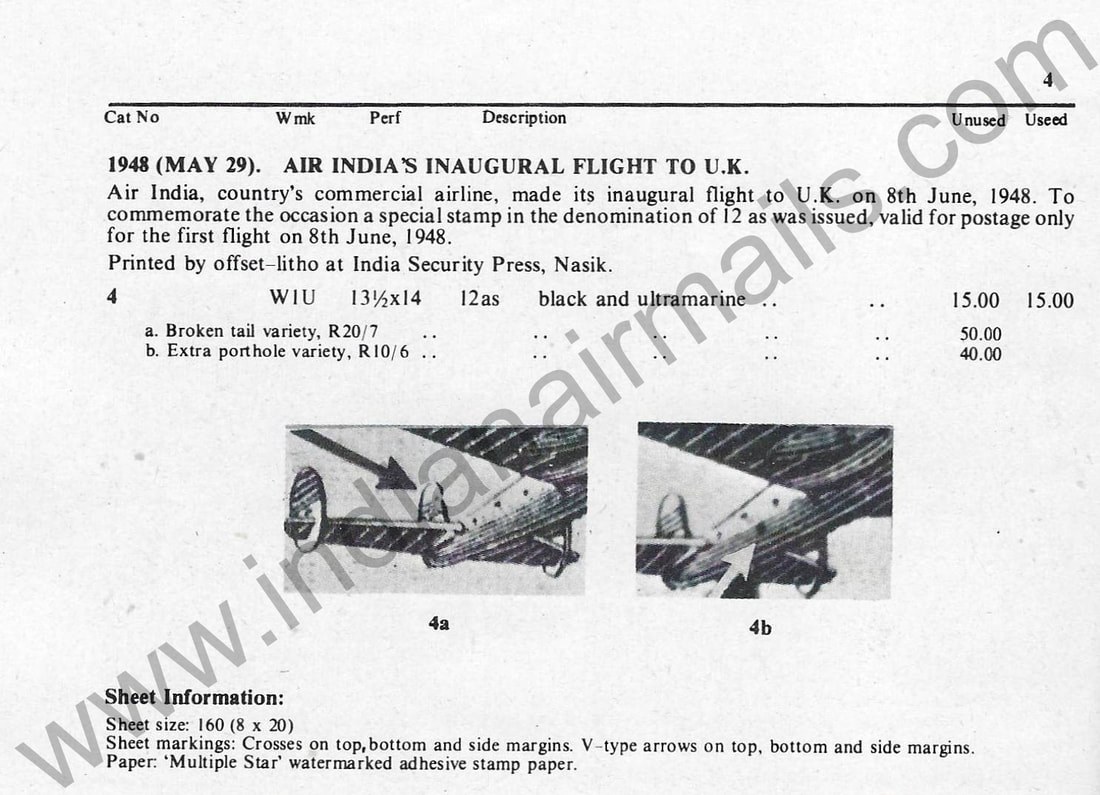
On 8 June 1948, Air-India International launched its historic service from Bombay to London, with intermediate stops at Cairo and Geneva. The flight was operated using the elegant Lockheed Constellation, one of the most advanced long-range airliners of the post-war era. The inaugural aircraft, named Malabar Princess, carried passengers, cargo, and mail, symbolizing India’s entry into the global aviation network.
To commemorate this milestone, the Indian Posts and Telegraphs Department issued a 12 annas postage stamp (Fig.1) on the same day. The design depicts the Lockheed Constellation in flight with the inscription “Air-India International – First Flight – 8th June 1948.” |
Fig.1
|
The stamp reflects the optimism of a newly independent nation and marks the beginning of regular international airmail services operated by an Indian airline and the postal instruction was very clear that this stamp was meant to be used on only on 8 June 1948 and only on the inaugural Bombay-London service. For aerophilatelists, this issue is particularly important. Covers carried on the inaugural Bombay–London flight, often bearing commemorative cachets, represent the earliest examples of international airmail transported by India’s national carrier and are highly valued in postal history collections.
The French India “Chidambaram Temple” Stamp
Interestingly, the same date—8 June 1948—is associated with another remarkable stamp connected with the Indian subcontinent. This stamp was prepared under the French colonial administration of French India, which then governed the settlements of Pondicherry, Karaikal, Yanam, Mahé, and Chandernagore.
|
The stamp (Fig.2) depicts the famous Chidambaram Temple, dedicated to Nataraja, the cosmic dancing form of Lord Shiva. The temple’s towering gopuram dominates the design, while above it an aircraft is shown flying across the sky. This striking combination of sacred architecture and modern aviation creates a powerful visual contrast between ancient heritage and contemporary technological progress. The stamp bears the inscription “Établissements Français de l’Inde” and was printed without watermark with perforation 13 × 12, with a denomination of 3 Roupies. However, the issue soon became problematic when French authorities realized that the Chidambaram Temple was located outside French territory, within independent India.
As a result, the stamp was never officially issued in the French Indian settlements. A small quantity reportedly appeared for sale at the Paris Post Office during 7–8 July 1948, after which the issue was withdrawn. Because of this limited distribution, the Chidambaram Temple stamp has become a notable rarity in the philately of French India. |
Fig.2
|
Unique Philatelic Connection
On 8 June 1948, by remarkable coincidence two postal administrations connected with the Indian subcontinent produced stamps featuring aircraft. The Indian issue commemorated the inaugural international service of Air-India International, marking India’s entry into global aviation. The French India stamp depicted the Chidambaram Temple with an aircraft flying over it.
Sharing the same date and aviation theme, the two stamps form an interesting philatelic link between the rise of India’s international aviation and the final phase of colonial postal administration in the region.
Acknowledgement: Thanks are due to Mr. Chaitanya Dev, Past President of the Karnataka Philatelic Society, for providing valuable information on the French India stamp.
On 8 June 1948, by remarkable coincidence two postal administrations connected with the Indian subcontinent produced stamps featuring aircraft. The Indian issue commemorated the inaugural international service of Air-India International, marking India’s entry into global aviation. The French India stamp depicted the Chidambaram Temple with an aircraft flying over it.
Sharing the same date and aviation theme, the two stamps form an interesting philatelic link between the rise of India’s international aviation and the final phase of colonial postal administration in the region.
Acknowledgement: Thanks are due to Mr. Chaitanya Dev, Past President of the Karnataka Philatelic Society, for providing valuable information on the French India stamp.